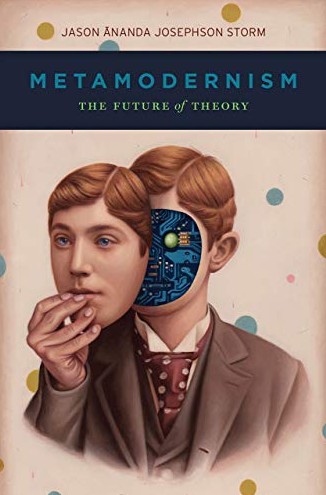
Jason Ānanda Josephson Storm, Metamodernism: The Future of Theory (University of Chicago Press, 2021).
The academy has become completely dominated and effectively paralyzed by the spread of postmodernism. Any non-deconstructive, creative enterprise is viewed with suspicion as a throwback to imperialistic modernist generalization. Anyone in the human or social sciences is laboring under the assumptions of postmodernism, even if they don’t realize it (1-3).
Knowledge has been effectively siloed, with the dizzying array of overlapping and contradictorily labeled “turns” as proof. Many different theories are arguing against postmodernism by means of postmodernism (3, 4). Postmodern doubt cannot be avoided, and on the other side of it there are some exciting possibilities: “postmodern doubt can be made to doubt itself, and when cleansed of its negative dogmatism and lingering longing for lost certainties it can show us the way toward humble, emancipatory knowledge. Anti-foundationalism can become a new foundation” (4). Storm views his project as the first properly metamodern philosophy. He casts his predecessors as art and cultural theorists who are recognizing and cataloging the metamodern shift (5, fn. 290).
Hagel is useful to Storm because of his dialectic of the negation of the negation. He views this type of dialectical thinking as allowing a “spiraling upward” or a turning of the sciences on their axis rather than the continual running in circles that has characterized theory in the last 50 years (6).
Storm defines the elements of “postmodernism” as “1) antirealism; 2) an emphasis on endings, which has often included disciplinary autocritique; 3) an extreme version of the linguistic turn that characterizes the world in terms of texts; 4) a broad climate of skepticism; and 5) ethical relativism (sometimes called ‘ethical nihilism’)” and agrees with historiography that characterizes much of the popular understanding of postmodernism as an American reimagining of the original French sources (9, 10).
He argues that what was new about postmodernism was not its content but its sway. He excavates some of the history of how it coexisted with seemingly antithetical elements (11). For one thing, postmodernism seems more accurately a description of certain trends within Euro-American cultural production than a global condition (12). Metanarratives, the deaths of which are supposed to be the defining feature of postmodern, have actually proliferated in the past fifty years. Postmodern philosophy itself spins its own metanarrative of “the fallenness of Being,” and so forth (13). Antirealism goes back to some positivists, and the linguistic turn and the resulting “death of the author” can be traced to 1940s New Criticism (13). General skepticism has roots in Cold War reactions against intolerant and non-liberal forms of society, and ethical relativism was certainly present in atheistic logical positivism. The difference, it seems, is that postmodernism is pessimistic about all these trends, while modernists were optimistic (14).
“Postmodernism” as experienced in popular discourse is in reality more a result of American receptions of secondhand sources and the simplifications and exaggerations that have embedded themselves in disciplinary formation for many fields (15). Many of the original postmodern theorists anticipated the move of turning postmodernism in on itself to reach some higher productive plane (16).
There are certainly issues with using modernity or postmodernity as periodization labels and even as coherent concepts in and of themselves. (15, 16). A solution might be to say that no periodization or “general cultural episteme” is total or complete (16).
Metamodernism as theory must be the sublation of both modernism and postmodernism in an almost Hegelian sense (18). Storm believes this new way of theorizing is necessary to break through many impasses that afflict all human social sciences (18, 19).
In reaction to modernism‘s fetishizing of “impartial distance,” postmodernism has similarly absolutized “standpoint epistemology” (19). By contrast metamodernism intends to be a “non-system system” and an “anti-universalist universalism” in line with its aspiration of transcending postmodernism by means of postmodernism (20).
Scholars may not realize it, but they all need “epistemology, ethics (or at least an intellectual goal), a notion of meaning, and a set of research methods for studying social kinds” (21). Storm’s book replaces anti-realism, disciplinary autocritiques, the linguistic turn, a broad climate of skepticism, and ethical nihilism with metarealism, process social ontology and social kinds, hylosemiotics, Zeteticism, and “a revaluation of values converging on Revolutionary Happiness” (21).
No discipline (not even political science or history) can actually fend off criticisms of its central categories. But in granting these critiques Storm will uncover an inverse that reveals something fundamental about social worlds and points the way towards a productive and resilient reconstruction (22, 23). Storm claims metamodernism solves several perennial philosophical problems, including the supposed dichotomy between “real” substances and things such as abstract concepts and processes, the problem of generalization, and the intractable skepticism of the linguistic turn (23). His book will show how doubting doubt can lead to new possibilities for knowledge. He proposes abduction as an alternative to the induction-deduction dichotomy (24). He even arrives at a kind of virtue ethics as a way of moving past the negative form postmodernism’s hidden ethics have taken. In sum, “Metamodernism can be conceived as a kind of philosophical therapeutics that leads through the disintegration of concepts and deconstructive vigilance to a kind of reconstructive capability directed at multi-species flourishing.” It aims to smash “phantom oppositions” (25). He draws from a range of sources, including queer, postcolonial, and Buddhist thought (25). The range of philosophy he integrates helps him arrive at the work’s strident antidisciplinarity (26).
Storm identifies “mind-dependence” as the concept that has escaped scrutiny but is largely responsible for the supposed absolute gulf between “the real world” and “social construction” (29, 30).
When scientific paradigms are in crisis, scientists will sometimes look to philosophy for direction (30). The reverse is also true. When philosophers and social scientist look to science, however, the engagement is often superficial and an attempt to insulate the existing categories from postmodern criticism. It’s a realism that says, my “scholarly definitions” are real (30, 31).
It would seem, though, that both allies of realism and postmodern anti-realist agree on the relative “mind independence” of scientific research and the “reality of commonsense objects” (31, 32). Simon Blackburn puts it this way: “On the one hand it seems absurd…. to question the reality of the objects of common-sense, or core scientific theory. On the other hand realism is often seen as demanding the mythical God’s eye view, whereby we step out of our own skins, and comment on the extent to which our best scientific theory corresponds with an independent reality…. In the one view realism seems almost indisputably true, and in another equally obviously false or undiscussable” (quoted on 32).
Realism could be defined as believing in the mind-independent existence of a world of physical objects (32). Mind-dependence largely overlaps with social construction. Things can be ontologically mind-dependent (it wouldn’t exist if people didn’t believe in it, such as the value of money), causally mind-dependent (concrete actions caused the creation of something, such as a dachshund, that wouldn’t have existed otherwise), and classificatorily mind-dependent (“arbitrarily” grouped together) (33, 34). These are primarily what scholars mean when they say something is socially constructed, “but with the added feature that accounts of social construction often emphasize a group’s (rather than an individual’s) role in the production of ‘X.’ Moreover, as discussed below, social construction theorizing tends to lean into the contingency of ‘X’ such that ‘X’ might not have existed without social forces” (34).
There’s been much confusion about what anti-realists or idealists believe. For example, “the foremost transcendental ‘idealist’ philosophers—Kant and Schopenhauer—did not deny the existence of a mind-independent world either; rather, in the broadest of brushstrokes, they shared the intuition that we come to know the world by way of our mental categories, but that noumena or things-in-themselves are not conditioned by those categories.” (36). Nobody is saying that there isn’t an external objective world. It’s just “that we lack access to it to some extent,” as Storm says (37).
Nietzsche eventually came to an anti-Kantian position that could be called anti-idealist, but Storm points out that both realist and anti-realist have argued both that there is no “real“ world outside of sense perception, and in the more positivist sense that there is some fundamental division between our mental states and the “real“ world of objective, physical things (37). For postmodernism, their supposed antirealism is more fittingly described as a sort of Husserlian linguistic “bracketing,” whereby our linguistic categories fail to “represent accurately a mind-independent world. But this is not the anti-realism it is often made out to be” (37). Rather, for both Jacques Lacan and Jacques Derrida, their position may be more accurately termed “traumatic realism.” Storm defines this as “an (ineffable) extra-discursive Real that is glimpsed briefly in moments when discourse breaks down and therefore indicates the presence of something troubling discourse itself” (37, 38).
Storm demonstrates how realism and antirealism actually converge: Rorty and the postmodernists (putative “antirealists”) say there is, for all practical purposes, no gap between appearance and reality. Sounds like we’re trapped in language games, right? But logical positivists like Rudolf Carnap also believe that, since “there was no way to verify scientifically the reality of the world outside sense experiences,” then there is no need to “conceptualize a real world behind that of appearance” (38). And with that we’re butting right up against Rorty’s position. “Philosophers can be accused of being antirealists for insisting on a mind-independent world beyond that of appearances (like Kantians), but they can also be accused of being antirealists for the opposite claim—denying a mind-independent world beyond appearances (like late Nietzsche and early Carnap). Moreover, one could adopt either broad metaphysical realisms or antirealism and be either pro- or anti-science” (39).
The assertion that the Real is defined as something that is independent of humans might be called apocalyptic realism, because it asserts that what is real is real insofar as it would still exist if we were gone. (39). Currently, both “social constructivists” and realists alike seem to agree that exposing something as socially constructed amounts to disproving its reality (40). But it goes without saying that something can be socially constructed and still quite impactful on people’s lives (41).
Storm is not offering the tired tautology, i.e., that people experiencing something are certainly experiencing something (with the insinuation that they are hallucinating or conjuring up their experiences out of thin air). Instead, he argues that “there are many different modes of being real or unreal, depending on what feature of the world we are considering. Indeed, many philosophical conflicts result from scholars holding different presumed but unstated contrastive categories” (42). Race may not be a determinative biological category, but it is certainly a real sociocultural one, for example. We should be skeptical when someone says something is not real, “especially when a contrast-class to real is left unspecified” (43).
In summary, “arguments for or against realism often signal broader ideological stances rather than definite positions about mind-independence” (43). Storm coins the term “metarealism”: “any philosophy that grants that the real comes in modes. Metarealists recognize that uses of the term “real” necessitate reference to a contrast class.” Without reference to that, the concept is either “confused or merely ideological.” Metarealism moves beyond modernist “realism” and postmodernist “antirealism”: it transcends them for a definition of the real that is mode-, context-, and contrast-specific (44).
Storm cautions that we should distinguish the terms real from existing, though (44, 45). Similarly, being and existing should also be distinguished. The fact that some languages other than English do not use the same words for predicative being and existential being “is evidence for the position that we can make true predicative ‘being’ statements about nonexistent objects” (45). For example, “the silver mountain is made out of silver” (45). Indeed, there are different “modes of existence” (45).
Storm’s training is in religious studies. He offers it as a case study for his proposed metamodern solution. Under modernism religion was assumed as a universal category among humans and cultures. Its expressions, content, and particulars varied, but “deep down” there was a real universal object that could be discerned through reason and experiment (49). Under the barrage of postmodern critique however the idea of “religion” as an analytical object itself has come into question. Its existence has been instead called a creation of scholars’ own biases rather than an independently existing concept. Amazingly, this deconstructed process has been played out in almost every social science discipline (49, 50).
In the 50s and 60s the initial postmodern critiques of a number of fields began: art, society, culture, science, the political, the law, history, and, as stated, religion. Rather than describe all these critiques in detail, Storm aims to provide an interpretive master key that unlocks the modernist and postmodernist substructures undergirding their fundamental dichotomy (51).
Both contemporary analytic and continental philosophy agree that “concepts, which we are fated to use, are inherently problematic.” The abandonment of the Platonic and Aristotelian idea of “essences” (and the resulting philosophical search for better definitions for them) has detached philosophy from ever coming into contact with stable, universally agreed upon ground (52).
Storm relates the process of dissolution as it occurred in religious studies: “First, heterogenous beliefs, practices, and institutions are subsumed under the concept of a particular religion, which is then imagined to be the repository of a coherence alien to it; second, a set of religions is incorporated into the category ‘religion’ as such to describe what is reported to be universal to humankind. Each phase of this movement results in the loss of resolution, the blurring of distinctions, and the compression of the diversity of elements” (54). “In sum, religion is an abstraction of an abstraction, and each phase in this process results in an un-recouped remainder” (55).
The very concept of religion implies a meta-position that relativizes every religion and therefore renders the concept impotent. Further, to posit “religion” requires a “secular” which again destroys religion: if there’s somewhere religion doesn’t apply (i.e., in the secular), then it’s not religion at all. It’s rooted in Euro-American Protestant preconceptions (55, 56). But so many scholarly projects—on the right and left—required a category called “religion” that this fundamental question was largely sidestepped (57). Though the core idea has been repudiated, the archaic taxonomy that flowed from it, which gave us our list of “religions,” has remained (58). “Brent Nongbri, for instance, has argued that no pre-modern terms can be defensibly translated as ‘religion’ because to do so necessarily excludes important meanings of the older terminology and sneaks in modern assumptions” (59, 60).
“Religion” went from a way of communicating, not a dogmatism, but a relativism. The deconstruction of everything has rendered everything equally valid and equally dubious (61). Storm aims next to fracture the master categories of the social scientist to be able to “see what they have been hiding and discover a new basis for a reconstructed humanities and social sciences” (62).
Starting with the transgressive experiments of the Dadaists in the early 20th century, but being more fully articulated by Morris Weitz at mid-century, the concept of art was linked to Wittgenstein‘s family resemblance concept. This means that there was no exhaustive set of qualities or characteristics that subsumed all of what art is. Such concepts either fall short of including everything that is art or are so expansive that they become meaningless. But the concept of a family resemblance category allows certain asymmetric qualities to be shared across many objects without needing to locate a fixed essence or set of qualities common to all of them (62, 63). On top of that Weitz noted that art was an “open concept,” meaning that its boundaries and definition are always being challenged and expanded; artists will always change the meaning of art (63, 64).
Weitz argues “there is no necessary and sufficient conditions for membership in the category art, art has no essence, its meaning is always evolving, and objects hitherto classified as art have no inherent common features” (64). This leads to the conclusion that aesthetics as a whole is nothing more than post hoc justifications for personal preferences (64). Critics went deeper as time went on and exposed art as an arbitrary European invention rooted in “connoisseurship and notions of the experience of the observer” (65).
The category of art served to separate its objects from everyday life, from things like tools, but then came an avant-garde movement that sought to reunify art with everyday life, eliminating even that avenue of definition (65). Since autocritique has infiltrated almost every discipline, Storm has analyzed the strategies employed and abstracted from them a how-to for concept destruction (66).
His first route is the “immanent” one. First, one just has to collect multiple definitions of the master concept: and in every field, these exist. Rival camps are always arguing over what makes sense to include and what doesn’t. Next, expose the internal inconsistencies. Even if you know something is part of your category, there is a definition of that category that excludes that something. And there are other things that feel wrong to include that somehow still meet the definition (67). Third, pull a Wittgensteinian move and just say that it’s a “family resemblance concept” or something similar. The particular objects share some but not all of the identifying marks. But that soon disaggregates to an absurd degree (68). Step four is to abandon that and define the concept differentially, as one side of a binary. But soon it’s realized that the binary is loaded and terms aren’t equal and opposite poles on one continuum, but value-laden, muddy associations (68). An optimal step five is to go the nominalist route and say any category is artificially subsuming “irreducibly” different phenomena under one inappropriate umbrella (68, 69). “This leads to the charge in a host of disciplines that their own disciplinary objects are merely scholarly projections and not things in the world” (69).
His second route is the “relativist” one. First, historicize the object: show that its meaning has shifted over time and in response to the needs of power second, identify the victims. This can be done by linking the concept to colonialism, racism, sexism, etc. (70, 71). Third, demonstrate that other cultures either do not have a word for a certain concept or that the word commonly understood to be analogous is fundamentally different in its center or constellation (71, 72).
Next is the ethical line of critique. First and last, just show that all attempts at conceptualization hide covert forms of oppression. Show that critical objectivity is impossible (72).
Once these critiques are completed, the final flourish is usually to declare that the object in question “doesn’t actually exist” (73). For those disciplines which have resisted this assault, the reason is usually extra-scholarly sources of funding or investment (73). Economics is probably an example. Many disciplines now try to deconstruct themselves and explain away their content as either culture or politics. The irony however is that the same deconstructive strategies apply to the fields of anthropology and political science. There’s literally nowhere left to turn (74).
Science can also be subjected to these deconstructive strategies à la Thomas Kuhn. Storm offers that instead of thinking this denigrates “the scientific worldview,” we should instead understand that science consists of many knowledges, which can and are adjudicated from within subdisciplines all the time (75). Storm argues that there are more or less justified truth claims, and that while many of these more justified truth claims are from science, many also are not; for example, many historical claims. “We do not actually need an inflated and universalized category of science to support knowledge” (75, 76). “Concept” itself can be reduced to an unstable, contingent, variable concept! (76).
The proliferation of autocritiques is surprising because disciplines were founded in order to create self-enclosed systems, within which it would be possible to pursue ever greater clarity about the disciplinary object according to accepted rules (76, 77).
Turning into a Wittgensteinian model of loose family resemblance clusters does not fix the problem. Sure, similarities can be observed between objects in many different ways and respects, but an issue arises when certain objects are considered more prototypical than other objects, e.g., when a robin is considered to be a more typical “bird” than a penguin. The can is just kicked down the road: what constellation of features make the original a prototype of the kind? Also, when categories are combined, the meanings can change altogether. And everything is similar to everything else at least in some respect (77-79). “Perceptions of similarity say more about one’s perspective, purpose, and perhaps prior linguistic categories than they do about anything else. This has direct implications for how we construct scholarly objects” (79). Family does a lot of covert work here too: “describing something as a family-resemblance, presupposes rather than explicates a similarity,” unlike in human relationships, where it indicates a deeper genetic connection (79, 80).
“Polythetic” concepts are another attempt at a solution. The idea is that entries in a group may not all share the same properties, but do share some combination of some of the properties. Put simply, “members of a polythetic class are not all equally similar to each other.” But this breaks down when you realize that such polythetic concepts are conceivable as smaller subgroups, calling into question the utility of the grand polythetic master category to begin with. Also, the features themselves are usually reducible to further polythetic sub-concepts, creating a labyrinth of messy and nested overlapping definitions (80, 81).
Polythetic categories “postulate rather than explicate themselves; they are inevitably decomposable into further polythetic categories; they fail to answer how many polythetic features are necessary to make up a class; and they provide no justification for generalizations” (82). Storm will demonstrate later, though, how categories can be composed of loose clusters of attributes.
The classical Platonic and Aristotelian view was this: “concepts were supposed to be grounded in definitional structures explicating their essences and describing the necessary and sufficient conditions for their use. The aim of philosophy and then the special sciences was to discover or sharpen the definitions of real concepts, which were supposed to reflect accurately the divisions of nature or culture” (83). The initial salvo of critiques came in the wake of the posthumous publishing of Wittgenstein‘s Philosophical Investigations in 1953, which means they preceded postmodernism. Another wave of critiques, very similar, but usually with reference to the postmodernist thinkers, occurred in 1980. It seems that the postmodernists were naming lines of philosophical inquiry that were emerging from many different quarters simultaneously (83). “The concepts in the human sciences fractured in similar ways because they are in some significant sense similar concepts. If this is the case, a new understanding of concepts and even knowledge can be built—not on a defense of the categories, but from the structure of the critiques themselves” (84).
Anti-essentialism was heralded as a type of emancipatory movement in fields like feminism and post-colonialism. Recently it has been incarnated in a new series of word substitutions such as enslaved for slaves, unhoused for homeless, etc. “These word choices are typically explained as an attempt to emphasize actions or choices over fixed or inherent characteristics,” and they are grounded in “the failures of the grand project of definitions of philosophy discussed in Chapter 2” (85). The problems with anti-essentialism though are exhibited in the contradictions that feminism encountered; to wit, if there is nothing that defined women, i.e., if they have no unique essence, then how can they be emancipated as women? (86) To be anti-essentialist to the very end ultimately “precludes the use of language,“ as Jane Roland Martin observed (86).
Storm proposes a “process social ontology.” “Process theorists generally reject the notion that everlasting substances are the most basic constituents of existence and argue instead that what appear to be enduring entities are really temporary stabilities and unfolding processes.” Essences are not primary; Storm says they’re ultimately not even real (87). Having participated in demolishing the categories, Storm now intends to rebuild them with “social kinds” (88).
Storm points out that ontology is used in two different senses. The first and classical sense is as the study of what actually exists and how it exists. The second sense is in describing how a particular culture might describe the world as existing; e.g., what spirits they posit as influencing the world. He aims to do ontology in the first sense, but his ontology will look at the “basic existents of the social world” (88).
Charles Taylor argued that the social sciences, or the human sciences, are different from the natural sciences. The natural sciences can be explained in terms of the same range of concepts whereas the social sciences address “open systems” that bleed into one another and are constantly in flux, making prediction all but impossible (88, 89). And it seems that most scholars agree that the content of any field, just like any language or tradition, is constantly changing and evolving. Stability then is only an illusion (89, 90). If this is the case, then the task turns to understanding, instead of a world of essences, a world in motion, in process. “The thing that needs to be explained is not social change or cultural differences, but relative stability or similarity” (90). But these “social kinds” and processes should not be mistaken for “natural kinds” (90). Natural kinds are “collections of individuals with common, consistently identifiable properties that we can refer to as ‘kinds’” (91). The chemical elements fit the ten listed “elements” of natural kinds, and an essentialist might imagine ultimately everything can be described in this way. But as Storm demonstrated in Chapter 2, the social sciences definitively cannot be described as natural kinds (92).
Storm finds it ironic that anti-essentialists in the social sciences have based their critique of natural kinds in human endeavors on an essentialist reading of biology because in biology itself essentialism has been under attack for a long time and has resulted in many biologists converging on a position recognizing everything as process-based flows. “Many of our social kinds are not biological categories and should not be mistaken for such (e.g. race), but rejecting essentialism isn’t the right way to distinguish between biological and social kinds, because many biologists also reject essentialism about biological categories and some have even argued that there are no natural kinds in biology” (93).
Instead of reifying the disciplinary objects, we can note that they are instead “high-entropic,” meaning “they are multi-variant, diverse in their instantiation, consistently changing, and often lacking in equilibrium. Furthermore, it would seem there are few if any properties possessed by all members of a social kind category” (94). Social kinds exhibit many properties that mark them as different than natural kinds: they’re undefinable as it relates to an essential list of properties, they’re independent, they cut across one another, and they are abstractions that lose details in their very articulation (95). They are also historically/culturally contingent (i.e., if history had been different, they would be different, or if power had wanted them to be different, they might be different), normative (or suggesting values), and mind-dependent, which means they require human belief or activity to exist. “Processes have a different grammar than substances. They are verbs rather than nouns.” They are patterned activities rather than containers (96, 97). This makes the question not, “Is this art?” but, “When and how is this art?” (97).
Compare a substance (such as gold, which is based on a stable set of properties) to a process (such as a thunderstorm): “the logic of substances is based on distinct boundaries and relative stability, the logic of a process is one of components, context, stages, cycles, phases, and conditions” (98). If social kinds are processes, they lend themselves to being understood as feedback loops: matter to meaning, and vice versa (98).
Subjectivity itself is processual, on this vein. Rowland Stout argues that dynamics are more accurate a description of mental life: you’re closer to what you’re doing, thinking, and feeling right now (which is an ongoing process) than you are to your conceptions of past states or identities you previously inhabited. Call it an “ontology of relationality,” which “allows us to emphasize the relational co-emergence of individuals and their environment” (99).
The problem has been that we have tried to fit what are essentially processual social phenomena into an essentialist, “natural kinds” mold. In reality, all social entities are Foucauldian lineages, historically conditioned assemblages that are constantly in flux. Saying they’re “not real” on account of these facts is unhelpful and, in reality, missing the point entirely. “We can make certain generalizations while also recognizing that we are talking about processes in flux, and that whatever we say now can and will likely be subject to change in the future.” “To exist as a social entity is to be conditioned, to be the product of causally unfolding processes” (99). The human body itself admits of a similar provenance: all the cells turn over every 15 years; is it thus the same body? In one sense at least: it is “an unfolding process with a particular causal history” (100, 101). A river is a good example. It has tributaries, it forks, it empties into a body of water; but we can be sure that the Mississippi River is not the same river as the Tigris River, even if the boundaries and definition of the Tigris River are never fully quantifiable. “Instead of necessary history or arbitrary flux, we have path dependence” (101).
Likewise, “many of the deconstructive criticisms of the disciplinary master categories amount to identifying errors stemming from reification, atemporality, and misplaced concreteness—in other words, faults rooted in misidentifying the processual nature of social kinds” (101). Storm says even the archetypal natural kinds, the atomic elements, technically are the results of processes (“atomic fusions produced in the nuclear furnaces of stars“), even if they look stable or even eternal from a human standpoint. Biology is less so, and the social sciences, even less so. Storm is laying the ground for process to be “an ontological fundamental” (103). Anti-essentialism turns the lack of essence into an essence; process thinking, if used to understand phenomena rather than simply to smuggle in skepticism and nihilism, can help us gainfully study the world (103, 104). Process social ontology, unlike critical realism, which ultimately does aspire to make the social world into the same type of thing as the natural world, “enables new means for both classification and study of social kinds without presupposing them as static categories, permitting us to build a new theory of social kinds on the bubble of ‘postmodern’ critiques” (104).
“Methodological individualism” held sway in the social sciences for a long time, which argues that only individuals actually exist and what we perceive of as society and social forces are just the aggregates of individual choosing agents’ decisions. But even with the shortcomings of its rival, “holism,” there seems to be something to “emergent phenomena and higher abstractions”: society is more than the sum of its parts (105). For Storm, “the social is not reducible to individuals or amorphous social forces, but consists in a range of different social kinds, best understood as temporary zones of stability in unfolding processes, which are instantiated in their materialization” (106). This includes animal social arrangements as well, breaking down the supposed tension between nature and culture (106, 107).
Groups can’t just be reduced to the aggregated properties of their individual members. Take a church made up of ten individuals. The church could’ve been established hundreds of years ago. But those ten individuals were not established hundreds of years ago. Clearly, the sum did become more than its parts in some way (107). “While some New Materialist thinkers have attempted to suggest that the meaning of an assemblage is equivalent to the matter that composes it, the ubiquity of multi-realizable social kinds pushes against this kind of reductionism” (108). And “many social kinds interweave what could be called social, physical, and even biological properties” (108).
Storm references Richard Boyd’s concept of “homeostatic property clusters” (108). This is the theory that in biology, “natural kinds” are groupings of traits that have a tendency to aggregate and stabilize because of internal and external pressures. They are snapshots of relatively stable arrangements of qualities, and members of such groupings will mostly share these same qualities, but there’s no strict “in/out” determination, and it’s understood that because of mutations and changing environments, all such groupings will tend to change over time. And all this is in reference to some “disciplinary matrix,” because of course human concepts are involved in some way in demarcating these various groups. Storm thinks this is a good model for theorizing social kinds (109, 110).
Concepts are not the same as social kinds. They play a role in shaping the social kind, “but a social kind is not merely whatever a given individual conceives it to be” (111). My concept of an investment banker and the social kind “investment banker” are not exactly the same. For instance, there’s much about investment bankers that I don’t understand, so the social kind exceeds the concept (111, 112). Social kinds are also “enmeshed in evolving social practices”: they are always at least slowly evolving (112).
Exploring social construction, Storm quotes John Searle: it’s created “by the collective intentional imposition of function on entities that cannot perform these functions without that imposition,” such as the imposition of the concept of “money” on a piece of paper printed with ink (112).
Meaning is not restricted to language, and it can be voluntary or involuntary. This leads to another kind of social construction (besides his initial ontological, causal, and classificatory possibilities), representational: “sometimes to be socially constructed means to be produced as a sign, to be given the power to represent” (111, 112).
For social kinds, Storm proposes clusters of “powers” rather than properties. His account of powers necessarily subsumes properties and catches more of what objects and systems “do”: and they do these things aways within a system, relationally. Money, a heart, etc., all require multiple actors and dependent networks to do what they do. Powers can be properties if they’re actualized and capacities or dispositions if they’re merely potential (114-116). “Social kinds function in ways that confer a mix of effects on their holders. Many social kinds are even transient” (116).
“It is better to think of social kinds in terms of a space of bounded variation about which one can make useful generalizations, rather than in terms of a centering ideal from which individuals depart”; “this theory of social kinds necessitates a description of the constraints on the variation built into the social kind” (116). “In sum, descriptions of social kinds are typically limited to delineating what would normally be their clusters of powers in the absence of other intervening causal factors” (117).
“Homeostatic” also need to be qualified. It’s just as likely that a social kind includes bounded and stable bifurcations and differences as well as similarities; for example, during apartheid, “South African citizen” included many shared qualities and also differences, such as the difference between white and black, and that difference had important implications (117).
Social kinds also need a geographic and temporal horizon. This is more common than you might think: for example, to give the population of any specific city, it’s important to know both the geographic definition of that city, and the date on which the population count was made. “Recast, any account of a social kind’s cluster of powers is going to necessitate some kind of specification about time and place” (117, 118).
Next, the key to solving why Wittgensteinian family resemblance occurs, and when such families are strong and generalizable, and when they are weak and don’t actually hold, is the question of what caused them. “Describing the powers of specific social kinds is only part of the picture; we must also discover the underlying causes that produce clusters and powers” (118).
“Multiple distinctive, causal, anchoring, or stabilization processes … give social kinds their shared properties and powers” (119). The first is dynamic-nominalist. Analyzing these types of categories “typically proceeds not by searching for a broad definition of the category in question, but by trying to figure out whose interests are served by the construction of the category and how those interests have resulted in attempts to constrain the category’s meaning” (121). It is naming, but it’s also the feedback loop and social environment that lead to the naming and its evolving definition (120, 121). Differences are as important as similarities in this process, and their positions within a “conceptual web” (121).
Second is memetic processes, which means the kinds that arise as a result of copying within some environmental constraint. Memes and genes, for instance, “copy” but also vary within a certain conceptual or environmental constraining environment. These kinds are usually also named (so dynamic-nominalistic) but that is not their chief causal mechanism (121, 122). “Many social kinds share properties because of reduplication processes combined with social pressures toward conformity. Fads and fashion trends are paradigmatic examples” (122). A subtype might be “path dependency” mimesis. This is where a copying process is a result of “self-reinforcing sequences that made it more advantageous to duplicate an earlier standard rather than adopt a new one” (123).
Finally, ergonic convergence is the phenomenon of shared properties “through a process of selection or design intended to fulfill a certain function.” It’s like convergent evolution in biology: no shared origin, but an analogous endpoint based on similar selection pressures (123).
We cannot use ergonic convergence to explain “actions by their consequences instead of their causes,” and “it is important to identify not just the need, but also the niche or environment that constrains response to the need, as well as the causal mechanism or process that can explain individual or collective decision-making.” We also have to carefully distinguish functional from non-functional qualities, because the nonfunctional ones will not have been selected for ergonically (125, 126). “Social kinds can be transformed by being analyzed, but … if we can gain knowledge of them at a faster rate than they are transformed, then studying them is still useful” (127).
Storm calls for a “reflexive human sciences,” which is a call to study how studying the disciplinary objects ends up altering them. Literary theory needs to study how novels written under literary theory differ from previous novels, for instance (127).
We reference social kinds constantly, and we differ in exactly what we mean by them, but since they exceed their reference (i.e., they always mean more than anyone’s concept of them because concepts are finite and kinds are complex), it more or less works. It doesn’t help, though, that people often mistake social kids for eternal, unchanging “natural kinds” (129, 130).
Storm acknowledges deconstruction as a useful tool for exposing the relativity and variability of social kinds but proposes the methods be tweaked in certain ways (130). “If we recognize that all social kinds can be debunked and that their heterogeneity renders them no less “real,” then it undercuts the deconstructive force of much skeptically tinged scholarship… we have to stop acting so surprised when we find out that a social kind is socially constructed. To be socially constructed is to be relational and processual, not nonexistent” (131). There’s also no essential “purity” to social kinds. Hybridity is the rule, not the exception. “De-reifying social kinds should open the way to even more crossings, to our ultimate benefit” (131). Also, since social kinds are not reducible to the terms we have for them, we can rest easy when exploding them and really excavate what lies beneath our concepts without worrying that we’re eliminating the object of study altogether. We can uncover complexity at previous unities that were imposed over (132). We can also get at the underlying anchoring processes that create social kinds and determine why specific instances are members of the same kind (132, 133). Finally, Storm emphasizes that a full knowledge of how a social kind has been put together can aid in reconsidering or reconfiguring it (133).
“Comparison can provide information about either of the subjects to be compared, but not the category often supposed to be the axis of comparison… Similarity itself is trivial and task dependent. So the utility of such comparison on its own would be limited” (133, 134). There’s no reason to fetishize similarity or difference (134).
“Tracing similarity of power-clusters that share the same anchoring process can tell you when generalizations are apt. The better we understand the causal processes that glue the properties together, the better we will be able to predict where these properties will hold and where there will be exceptions. Thus, while apparent similarity or difference might be a good starting place for research, to rise to the level of explanation requires that we specify first that the causal, anchoring processes that have produced the kinds are shared; from that basis, we can go on to analyze their similarity” (135). We can make more or less accurate generalizations by understanding what scale we’re working at and what anchoring processes or property clusters we’re trying to analyze (135). [This is a major feature of all metamodernism!] Indeed, “different levels of abstraction produce different notions of what counts as a single causal mechanism” (136). The same social kind can be analyzed in very different ways: economically, architecturally, legally, etc., and each analysis only captures some limited aspect of the object. So once again, the vantage point can determine the limits of the kind, and this changes based on that vantage point (136).
We should be pragmatic about studying social kinds and understand that we can aggregate or disaggregate. Aggregating means zooming out and papering over differences for the sake of identifying real property clusters and functional anchoring processes, while disaggregating means zooming in and losing explanatory power to gain accuracy and specificity. Both are valuable practices (135, 137). This is one area where Storm’s project truly exhibits metamodern characteristics: even though social kinds are identified and defined relative to a human-created explanatory project, this still does not mean that our social kinds are completely ad hoc or fanciful. They’re only “fake” in relation to a materialistic explanatory project, which is itself a human creation. Things can be relative to a mind-dependent system and still really describe things in the world. Social construction does not equal unreality. This is metamodernism’s both/and (137).
Social accounts cannot be confused with our terms for them. Vocabulary shifts, the same words can refer to mutually exclusive concepts, referents are disputed, etc. Many times we must “specify and then ascertain empirically which power-clusters and anchoring processes are determinate for a particular social kind in the relevant context” (138).
Avoiding the problem of Derridean definitional slippage has spurred many scholars to just fall back on the words and definitions of their sources. But this is also not sufficient, as even “common sense” definitions hide incoherencies, misunderstandings, and disagreements. We must instead always “investigate the foundations that underline the existence of the social kinds” (139, 140). Social kinds are not identical to people’s concepts of them (140).
This investigation is almost the flip side of a Foucauldian genealogy: variation and change are the norm here, rather than stability. What needs explaining is stability! Social kinds and their power-clusters are formed by contextual anchoring processes that work in a feedback loop with the kind to continually produce it (140, 141).
Social kinds are only useful in relation to a certain purpose. They “have to identify an actual causal process that produces actual property-clusters.” A problem arises though: the social world is disjointed, overlapping, and duplicatory. “This suggests a limited conventionalism (or, one might say, pragmatism) in how our kind categories are stipulated” [This is another key metamodern marker.] (141). Any kind can be viewed as the same kind or a different one depending on the level of analysis (141). However, even though “we should suspend the object laid open or disaggregated,” we should also reject “the fallacies of both essentialism and brute anti-abstraction.” How very metamodern! (142)
With social kinds, “errors of similarity, and difference can go both ways. Scholars consistently assume other cultures are either more similar to or more different from their own than is actually the case. Comparison is a nearly unavoidable byproduct of translation” (142, 143).
Storm gives the example of a hammer, demonstrating that its “membership in a broader set of kinds is situationally and contextually dependent (143, 143). Storm concludes by explaining what social kinds are in relation to “religion.” In line with a Buddhist or Derridean reading of the only true constant in reality being flux, I would say that one can start to understand social kinds as being phenomena that gather around them certain properties or powers as a result of similar causal anchoring processes. This results in different religions sharing similar but never identical properties. Religion as a concept is applied to these objects of study that attract these types of qualities and that arise in these similar ways, and the term itself has modified and interacted with the actual objects in determining their slow evolutions across time (145, 146). This is a metamodern approach because it neither tries to discover a core unchanging, essential concept of religion that holds across all instances of the category, nor does it in a postmodern fashion despairingly conclude that the category is a meaningless self-interested invention. Rather it grants the deconstructive critique while also optimistically reasoning that the concept gets at something real in the social world that can be understood and studied in a never-ending feedback loop.
Possibly at the root of the misunderstanding of language by both modernism and postmodernism is the confining of language to humans alone (150). Storm proposed a “hylosemiotics,” a “pan-species model of signs and meaning itself”: “after naturalizing philosophy of language around non-human models, the project then emphasizes the materialized representations that mediate cognitive processes to produce extended minds” (152). The two opposed camps of poststructuralist semiotics and New Materialism are both wrong in different ways, and Storm navigates this opposition by “recouping the emphasis on semiotics from the first and the turn to matter from the second,” thereby sublating them into something higher (152).
Broadly speaking, postmodernism as the “linguistic turn” could be said to culminate in the idea that human knowledge is nothing but the free play of floating and relative signifiers with no underlying point of reference (152, 153).
Storm asserts that poststructuralism is “an American invention largely assembled from a bricolage of French theorists merged with a handful of doctrines drawn from an older stratum of American New Criticism.” The linguistic turn was much older than postmodernism. Yet the semiotics that came from this stew is called now “poststructuralist” and is what is commonly thought of as postmodernism (153). It derives at base from Ferdinand de Saussure’s linguistic school of thought which emphasizes the arbitrariness of the linguistic signifier as it relates to a signified concept, and it posits that meaning derives from a signifier’s position within an overall web or structure of signifiers (153-155).
“Semantic holism comes in different variants, but it often amounts to some version of the idea that the meaning of a term or sentence is merely its relationship to either a subset of a language or a language as a whole” (155). Storm argues that semantic holism suffers from the fatal flaw of postmodernism: logical inconsistency. If an entire language must be understood to understand one word, then many such “one words” have to be understood before one can understand the entire language. This is the problem of the “hermeneutical circle.” Also, if external reference is not a part of language, then it would be impossible to communicate. How could interlocutors ever check their references? (155, 156). The postmodernists like Derrida pointed out the impossibility of all this, but left readers with little solution as to what to do about it (156). “Any attempt to pinpoint meaning (or arrest its dissemination) was seen as misguided. Translation was thought to be impossible. Every interpretation was taken to be equally valid. Humans were seen as uniquely imprisoned in linguistic mediation. Hermeneutics was seen as an inescapable circle” (157). This is why Storm calls poststructuralism “an unsuccessful philosophy of language” (157). Sadly, poststructuralism hypocritically went on claiming that meaning is impossible and every interpretation equally valid, even as poststructuralists continued to interpret texts and judge one another’s interpretations—but they “did so without the benefit of a theory of language to justify” their behavior (157). The poststructuralist idea that there’s no accessible reality beyond the maelstrom of signs and their slippery interpretations doesn’t hold up when we consider animal communication or the fact that everyone has to concede the existence of better or worse translations (158, 159).
New Materialism, on the other hand, though founded explicitly to confront poststructuralism, is in debt to it for much of its vocabulary and conceptual structure (159, 160). It only really makes sense in light of a misreading of poststructuralism: its insistences on the existence of the external world amount to truisms when viewed separately from that debate. And as Storm indicates in Chapter 1, no one in the poststructuralist camp was claiming that the physical world didn’t exist, just that it might well have not (160, 161).
The matter of objects in an assemblage does not always matter. “Not all of the matter that instantiates a given social kind is crucial to the social kind.… What is crucial is the part of the matter that has semiotic content or function… New Materialism cannot do much more with” (things like animal communication or the problem of translatability) “than focus our attention on the nondiscursive features of the environment” (161).
Storm offers in place of these two failures a third way that draws from both of them. He means to end the sequestration of matter from meaning here and to place “semiotic behavior” on a continuum with animal and plant sign-making (162).
He starts by asserting something undeniable: we indeed do navigate our world and communicate quite successfully. This categorically rules out postmodernism’s account of the world: that it’s “unknowable hyper-chaos or mutually non-overlapping linguistic universes” (162, 163).
Instead, the navigability of reality suggests it’s organized according to clusters of properties that vary (if it didn’t vary, the all-embracing “one” would erase all distinction, by definition). These clusters can be vague and often are, but they undoubtedly exist: green things, hard things, big things, etc.: things that can be “distinguished from one another” (163, 164). Any of the various ontologies on offer fit within this metaontology. It’s the minimal constraints that make the other ontologies possible. It’s the sine qua non for the world looking roughly like it unarguably does: a world where sentient beings have “even limited ability to navigate and have crude knowledge of their environment” (164). Our experiences of property clusters don’t have to be identical (or even tracked by the same sense organs) to be roughly generalizable across sentient beings: the proof’s in the pudding! (165, 166).
Language is not overly determined by our thought categories, but neither (contra the analytical philosophers) are our categories straightaway determined by the external world without reference to our mentally-dependent concepts (166, 167). “Mental-representations do not carve up the world so much as trace property-clusters and learn to recognize their re-occurrence. Neither words nor concepts categorize or subdivide the world as much as they tend to track certain aspects of it” (167, 168). [This is the metamodern “more or less,” or “good enough.”] And again, reference is task dependent, not eternal and unchanging (168).
We don’t learn new words by creating definitions, or explaining how exactly one thing is demarcated from another. Instead, we refer to the thing we’re talking about and label it with a word. Reference is the basis of communication and meaning-making. “Against much of analytic semantics, reference is necessarily conceptually mediated, but meaning is not reducible to shared concepts. Rather, utterances are used to guide inferences. Storm uses the example of a mountain: the definition of the mountain varies based on the context and intended use of the mountain; i.e., is reference being made for geological purposes, for hiking, for wayfinding, etc. (168, 169).
Neither we nor animals are mindlessly responding to stimuli. Every sense perception sentient beings experience is mediated by a mind, however rudimentary, that imbues these sensations with meaning, with significance (170). Meaning comes to us in “materialized signs” (171).
Contra some theorists who bifurcate types of sign-making, Storm advocates for a scalar gradation between voluntary and involuntary signs (171-173). “Voluntary sign production is the imposition on a material form of a function that makes it into a representation,” whether that be growls, words, letters, etc. (174). Voluntary signs are themselves social kinds. They are socially constructed, dynamic clusters of powers demarcated by causal anchoring processes (175). But they are social kinds that point to other social kinds. The English word “house” has its own social kind construction, evolution, and anchoring conditions apart from houses as physically constructed dwellings in meatspace (175). It can be put to radically different uses as well depending on context. But as a voluntary sign, its purpose is to “provide clues to a sign-producer’s meaning” (175).
Instead of “declarative truth-conditional” sentences, such as “Socrates is a man” being the paradigmatic examples of language, Storm proposes intention as the main form: is the intent of the sign maker being more or less successfully communicated? And this lets us arrive at vagueness as built-in to all communicative utterances. Context, time and place, etc., are always essential to language. Language causes one to infer, not decode. And that always has fuzzy edges (even for the sign maker himself) and those that hear him, and it always carries with it a presumption of shared assumptions and context (176, 177).
Storm modifies Boyd‘s system of the “naturalness” of natural kinds occasioning an accommodation within the disciplinary matrices that causes theory to at least approximate reality without ever exhausting it (177, 178). Voluntary signs emerge dialectically from an interaction between signmakers’ environments and their linguistic social kinds, and the chief controlling mechanism is success. Reference is part of language, reference to an external world; the thing to remember is that this reference is by definition vague, and that different social kinds at different times and places can refer to adjacent and overlapping property clusters. We can basically communicate across languages and even across the same language across time, because despite the evolving nature of both the external world and the voluntary signs we use to reference it, we can always be more or less successful in pegging terms to the outside world and signaling our intent to other signmakers about elements of that outside world (178-180). Words are social kinds that point not to “natural kinds” but to “fuzzy-edged” property-clusters. The hearer is inferring relevant meaning from a whole host of contextual and historical clues, and communication can more or less be achieved (180).
Storm has an answer for the poststructuralist assertion that there is no author or that authorial intent is impossible to discern. If we think in terms of property-clusters, which can be vague and overlapping, being the reference points that our voluntary signmaking is trying to refer to, it becomes “analytically clear both why there is no ‘objective’ meaning and why there can be really bad subjective readings.” Authorial intent can be harder or easier to get at even while being ultimately undiscoverable in the pure, “objective” sense. And of course, texts almost always overflow their intended meanings, or can be put to different uses based on new context and new information. These received meanings certainly change and evolve over time. Cheekily, Storm preempts his critics with: “if you’re tempted to disagree with me by denying that we have the capacity to discover authorial meaning, I want to note that to do so is self-refuting because it already presumes that I am an author whose intended argument you have accurately understood” (181). “Language does not encode intent so much as provide evidence for it” (182).
“Co-referring expressions have different anchors even if the result is often the same (e.g. referring to ‘animals with hearts’ or ‘animals with kidneys’ will pick out the same set of animals, but the references will be differently focused). Misunderstandings often come from different background premises or assumptions that are being brought to bear on the utterance in question.” (182).
Storm goes on a digression that illustrates that claims of certain words or phrases being untranslatable across languages is absurd: “to give a specific example of untranslatability requires being able to communicate to readers what has been lost in translation; but if you can communicate to readers what has been lost in translation, then the language in question is not in fact untranslatable… most of the works arguing for the impossibility of translation are full of translations, and the more evidence they provide, the more it weakens their argument” (185). “If you are willing to devote sufficient time and energy to it, anything can be translated” (186). It’s just that many times, a single word in one language is not translatable into a single word in another language. This is because, as social kinds, words are socially and historically conditioned with their own overlapping, but not identical, property-clusters and anchoring processes. How many of these contextual clues are brought to the fore is dependent on the purposes for which the translator is making the translation (186).
“Translation is not any more impossible than communication in general”: even words within languages can be translated, such as “bachelor” meaning “an unmarried man.” If the social kinds, context, and time periods are sufficiently different, a “thicker” translation may be needed, which gives more of the context and unspoken background assumptions. And we must not forget that all of these terms, both the social kinds to be translated and the social kinds that we might want to translate them into, are always changing. No two speakers anywhere, even within the same language, have identical concepts (187). “The limits of translation are roughly equivalent to the limits of language itself” (189).
Hylosemiotics’ theory of signs builds on Charles Peirce’s triadic sign structure: with Donna Haraway, he says that signs only mean something “to somebody,” meaning that meaning is “situated”: there are intended and unintended consequences that flow from the signifier to the interpreter that exceed or are not identical to the signified (189, 190).
Storm’s adaptation of Peircean semiotics is based on a definition of sentience as “sign-reading,” which could be everything from humans to plants and animals to even computers (191). This is different from New Materialism because agency in Storm’s system means the ability to choose, but in New Materialism it seems to be the same as existence, making it redundant (192).
Storm changes Peirce’s types of signs into aspects of signs, which are on a gradient and are not mutually exclusive (192). Symbol is the first. It is the classic Saussurean type of sign in that the sign does not have an intrinsic connection to the thing signified. It’s arbitrary (192). The second, however, is icon, which does bear this connection. This is usually in the form of a likeness to the thing signified (193).
Continuing the discussion of sign aspects: indexical refers to that aspect of signs that indicates position in time/space. Self-signs serve as self-identification. Correlational signs suggest a non-accidental, causal relationship. And the symptom is a sign indicating the presence of a disorder (194-196).
Storm next puts the modernistic Cartesian mind-body dualism in his sights. This “mental-phantasms-inside-me” vs. “physical-concrete-outside-me” opposition that has afflicted modern Western philosophy can finally be overturned under metamodernism. This inside vs. outside dichotomy caused Western philosophy to be overly concerned with giving the mind an accurate representation of the “objective outside world” (197).
First, it must be accepted that these clear demarcations don’t comport with our experience: the permeability we experience in just breathing, for instance. Or like how we become both subject and object when we clasp our hands together. All knowledge is knowledge through hermeneutic meditation: i.e., the outer and inner are inseparable (197, 198). It’s arbitrary to believe that a stomachache is bodily while a dream is purely mental! (197).
Contra modernism, knowledge of the world comes through exploratory manipulation of that external world rather than passive or detached viewing. Experiments with computers, rodents, and humans have demonstrated that the model of the world a sentient being has (perception) is built through his myriad interactions with it, not through gazing at it from within a sequestered “mind” (198, 199). This establishes a “coupling” between the agent and the world, with bidirectional flows of information and formation (199).
Next, matter and energy can be manipulated in the external world to allow us to offload memory tasks. The most obvious example, rued by Plato two thousand years ago, is writing. AI and computers represent the latest iteration of this integration between mind and world (199, 200).
Thirdly, public semiosis (the “more or less” shared understandings of things in the world or concepts) permit collective representations. These are based on private representations that, while never identical between minds, are similar enough that they allow collective “thought”: growth and manipulation of concepts socially. It’s akin to a jam session: the collective experimentation and play that can produce some new shared concept (in this case, new music) (200-202).
Material objects have a communicative function, but this is not to be confused with the New Materialist stance that they are on the same level as sentient agents: instead “what is relevant is the semiotic component or materialized sign aspect” of the material object (202). In summary, “knowledge does not come primarily from introspection, nor is the mind like some kind of homunculus looking outward from the windows of the eyes; rather, knowledge emerges from the exploratory manipulation of the physical world” (202).
In conclusion, yes, language is flawed and “reason is language” but what Storm points out is that language is also reason. Metamodernism completes the circle, pushing the linguistic turn past its initial conclusion and conjoining both ends of the mind-world linkage conundrum (203). Heidegger was right that Being is hermeneutics, but he was wrong about what that implied. Humans do not possess an inborn lack necessitating a search for meaning and exiling us from nature to a dark abyss. Rather, to be a sentient being is to be interwoven with an environment. We are all part of a cosmos that attempts to know itself” (204).
“Even dualists must grant that we can only get to the physical by way of the mental, and we can only get to the mental by way of the physical. Moreover, many of the questions we want to ask in the human sciences are about the beliefs and attitudes of other people, but we only get to access these beliefs when they have been externalized in the physical world” (205).
Translation is possible. It’s only impossible from within a modernist paradigm, wherein some God’s-eye-view “objective” reality is the standard of measurement: and in that case, nothing is translatable, even within languages (205). “When Thomas Kuhn wanted to demonstrate the incommensurability of scientific paradigms, he did so by comparing accounts of phlogiston and oxygen and in that respect rendering them commensurable. Kuhn thus undercuts his grand argument that one paradigm cannot be translated either into another one or into a neutral third point of view. Paradigms can be and often are compared” (206).
“Meaning is inference” (206). “There is no such thing as objective information, because involuntary signs generate different kinds of interferences in different contexts” (206).
The final part of the book is where Storm defends his theoretical work by attacking the postmodern skepticism regarding the possibility of sincerity and legitimacy when it comes to values (206).
In Chapter 5, Storm argues that although claims that the postmodernists believed that knowledge was impossible or that knowledge is nothing more than power are overblown and even denied by the canonical postmodernists themselves; still, the failure to engage with the actual problematics of postmodernism, both by partisans of extreme skepticism on the one hand and “Enlightenment-boosters” on the other leaves unfinished the business that postmodernism was about (209-211). He says this business is the doubting of doubt and the shelving of our unhealthy obsession with certainty in favor of a humble approach to knowledge he calls Zeteticism. Instead of deduction or induction, he proposes abduction “or inference to the best explanation” (211).
A posteriori empirical knowledge could always be an illusion or hallucination; a priori innate knowledge falls into a game of infinite regress (there can never be certainty about one’s understanding of logical principles or their absolute basicness as opposed to derivativeness). Even the cogito does not guarantee a coherent subject that will continue. The quest of philosophy since Descartes has been a fruitless quest for indubitable certainty with new forms of doubt bred every generation (211-213).
As he stated earlier, Storm castigates postmodern skepticism as an incomplete skepticism. Thoroughgoing skepticism would doubt even itself (213-215). He offers Zeteticism as an alternative to modernist certainty and postmodern doubt. This can help us avoid the dogmatism that is uniquely possible under apathetic relativism (i.e., if truth is unknowable, then the will to power becomes the only legitimate spur to action) (215, 216). Storm proposes being skeptical of everything, “including skepticism itself, but, crucially, that does not mean that everything is equally dubious. Some positions are better supported by the evidence than others. Doubt itself is even parasitic on the possibility of true beliefs (it only makes sense to argue that the world is an illusion in contrast to a non-illusory world) (216).
Zeteticism never claims to know absolutely but always leaves room for the possibility that the knower may be mistaken. This opens up possibilities for knowledge heretofore excluded (217). It’s the metamodern “more or less”: postmodern skepticisms become cautions, and the greater the stakes, the greater the burden of proof, with the caveat that there’s always room for revising our knowledge (218). Separate motive from an evaluation of the evidence but always keep motive in mind! (218) “Sometimes people in power are actually telling the truth” (219). We also don’t have “our own truths.” I can be and most certainly am wrong about certain things I believe, even about myself (219). “Recognizing it as a social kind means appreciating that knowledge is a process, not a final terminus. Zeteticism is a way of reframing knowing in terms of its impermanence” (219).
A helpful concept is Japanese Buddhist TANABE Hajime’s project of recognizing “that we are incomplete, limited, finite being[s] who cannot achieve liberation by means of Self-Power, but instead must proceed by relying on Other-Power” (220). Repentance is crucial to this endeavor, or the “turning” from hubris to humility and openness. It’s a very metamodern “philosophy in spite of itself” that gives us the fantasy of “autonomous reason” (220). “The mind is not a solitary ego peering out from our eyes. The classical ‘liberal subject’ is a myth. We come to consciousness not through self-reflection, but via a dynamical process of engagement with the physical world and with the community of other knowing subjects. There are no private languages” (220). Only “thought-collectives” actually make the discovery and accrual of knowledge possible (220). “Theories are social kinds, but their utility is based on accommodation to our community and the relevant causal structures of our environment” (221).
Relativism sounds like a concession to postmodernism, but in actuality every fact is relative to a context and a time. For example, saying, “The salt is on my left,” is relative to how I’m sitting in relation to the salt, and so is potentially true or false relative to my context (221). Storm says that all knowledge, over a long enough time frame, changes. Even the standards for knowledge change (221).
Evidential inference has traditionally been bifurcated into deduction, or finding “rationally necessary conditions” from established premises, and induction, or inferring general principles from particular cases. But induction can’t justify itself. There’s nothing intrinsic to induction that determines why some inferences hold and others don’t (223). Because we never observe every specific instance of a thing, we can never confidently say all the unobserved instances follow the same pattern in the observed cases (224).
Abduction is a basic and cross-cultural form of reasoning that works back from phenomena to their causes while ruling out alternatives (224). It “abduces” unobservable explanatory phenomena from observable data, with more or less confidence. It disturbs strictly empiricist inductionists (226).
Deduction is simply “truth-preserving” in that it draws out necessary implicit information from premises while abduction actually adds to knowledge, producing new information (226, 227). Also, relying on induction tends to produce the impression that only the initial sense impression (“this tiger has stripes”) is wholly reliable because the inference gets weaker the more it’s applied at a wider, more abstract scale (e.g., is “all tigers have stripes” really a reliable statement?). Carried to its conclusion, this can lead to a Humean skepticism about the reliability of any induction and even allows rational suspension of belief in the external word (227).
Abduction creates emergent certainty: any one piece of evidence may be inconclusive, but the cumulative weight can collectively narrow the possibilities down and produce greater certainty. Fewer and fewer hypotheses can reasonably fit a larger array of facts (227). Contrastive sets of evidence help us eliminate possibilities and narrow the possible range of hypotheses down, even if it’s theoretically possible that none of our explanations are correct: remember, Zeteticism isn’t overly hung up on absolute certainty (228). “Different explanations might simultaneously be accepted as ‘best’ if they explain different aspects or are useful for different purposes” (229).
Because Zeteticism is humble, it acknowledges its values and confronts its biases. This is much more realistic than aiming for objective, “value-free” analysis (229).
Storm argues that the traditional deduction-induction bifurcation of logic and knowledge is itself a problem. The way knowledge operates is much better explained by positing abduction-prediction as the main mode of knowledge production. In fact, both induction and deduction can be thought of as types of abduction. Good inductive reasoning hides abductive reasoning (i.e., a causal hypothesis is implicit in the observations and conclusion of an induction that causally links them) and perfect abductions are identical with deductions (i.e., if all other possible explanations can be excluded, then the remaining explanation is necessarily true). The inverse of abduction is prediction; abduction goes from past phenomena to a hypothesis while prediction goes from a hypothesis to future phenomena (230-232). Abduction also perfectly complements Storm’s system of hylosemiotics because both are premised on the dynamical interaction between situated and embodied agents and their constitutive environments (232). “It shows us that the discovery of patterns is not by itself sufficient for robust generalizations without an emphasis on the causal origins of their similarity” (232).
Contra postmodern cynicism: “under the shadow of incomplete skepticisms, speaking truth to power became doubting the power of truth; and often the structures of power were left in place” (233). Skeptical objections are rarely serious either: if you really believe an evil spirit is deceiving your senses, why would you be arguing about it? You can’t perceive reality anyway (234).
In sum: “postmodern skeptical positions, suggest latent epistemological commitments; their very uncertainty is motivated by a craving for absent uncertainties and a resultant investment in their own doxa and dogmas. When skepticism learns to doubt itself, it ceases to be skepticism and becomes metamodern Zeteticism” (234). We still need to guard against “epistemic overconfidence and false presuppositions about the autonomous capacity of our own rationality” (234). But “provisional knowledge is vastly superior to paralyzing doubt” (234).
Fallibilism is a similar position, but its proponents have been a bit too optimistic about the certainness of their knowledge. Zeteticism on the other hand emphasizes the provisonality of all knowledge and that everything we know could ultimately be overturned (234). “We need the right admixture of self-assurance and doubt” (234).
The ethical relativism and nihilism resulting from the widespread dissemination of postmodernism is supposed to have left society morally adrift and susceptible to cooptation by the crass bottom dollar materialism of global finance capitalism (236). On the other hand, postmodernism is also blamed as the progenitor of social justice, which is often decried as one of the most authoritarian and morally activist movements that have ever existed (237).
Modernism and science try to pride themselves on removing all values from analysis: there is no legitimate jump from is to ought (237, 238). But Storm argues “it is the very discourse of value neutrality that has caused us to embrace values that we do not name as such and perhaps do not even know to be values” (238). Storm aims to show why seeking value neutrality is misguided and how we can honestly bring our values to the surface and properly integrate them into practice (238).
Postmodern values are certainly exactly that, but they are framed negatively, such that they do not seem to be putting forth positive prescriptions so much as condemnations and critiques. The canonical postmodern theorists themselves claimed the mantle of moralizing and activist political ideology. Indeed, even the quest for neutrality and objectivity hides the positive value assertion that such things would aid in the pursuit of justice, righteousness, and fairness in scholarship (239-241).
Our moral language has been negative, as if we could covertly create the moral by only explicitly eliminating the moral. This leads us to confuse ethics and epistemology and to apply ethical critiques of our epistemology and epistemological critiques of our ethics (241). “Often this form of criticism gets its mileage by conflating the personal character or identity position of the thinker with his or her thought” (241).
Cordoning off ethics as an unserious part of scholarship has led to these covert ethics being insufficiently evaluated and critiqued, even while they are promoted ruthlessly and tenaciously. “Above all, we need to move past our negative line of critique not by abandoning it altogether, but by shifting our focus, acknowledging our own ethics at play, and arguing for what we do want to see rather than only for what we want to destroy” (242). We need to argue for our ethics unapologetically (242). Foucault might’ve been the canonical postmodern thinker to come closest to this (243).
The idea that values contaminate and make suspect social science research is derived from Max Weber but doesn’t necessarily follow from his perspective. Yes, he did divide knowledge between “what is” and “what should be,” but he was not so much interested in banishing values from research as he was in acknowledging them as separate from external world “facts” and not letting them overwhelm methods. He actually acknowledged their importance in motivating research in the first place and in making research relevant to the public (243-245).
In anthropology, the supposed origin of moral relativism is Franz Boas, but again, upon closer inspection, he appears to be actually arguing for a suspension of ethical judgment only to facilitate an accurate accounting of foreign cultural practices—once the scientific gathering of facts is done, he said anthropologists could and should critique other cultures (245).
“Hume’s Law,” that is, the taboo about extrapolating “ought” from “is,” could be traced not only to a certain passage in Hume but also the Cold War political squabbles of mid-twentieth century America wherein scholars sought to defend their scholarly enterprises against red-baiting McCarthyists. But even looking at Hume’s work, he himself did not follow his rule: he makes the jump from is to ought when it comes to human nature, and his “law” may be more about the limits of induction discussed above or logic itself than about value neutrality (246, 247). Storm then illustrates accepted examples of fact-to-value leaps that everyone already makes: for example, that we ought to believe true statements about the world; or that arguments and scholarly work can be evaluated based on breadth, originality, accessibility, etc. Even to say, this analysis should be rejected because it violates “Hume’s Law” is a contradiction, for the statement in itself is a value judgment trying to delegitimize value judgments! (248, 249).
Further examples include the scientific spirit itself, which is a value aspirational ideal ordered towards value-neutrality. Scientific facts have to be recognized by the scientific community, who share this ideal, before they can be recognized as such. Also, values are based on facts: people hold certain values based on their understanding of certain objective facts. For example, the disillusionment with the Catholic Church and the loss of religion for many Irish was a shift in values based on their understanding of certain facts about sexual abuse in the church (249, 250). Thick ethical concepts are another example. Things like sexism are concepts that are inextricably bound up with questions of fact and questions of value. There can be broad agreement, but they can also be argued and demarcated differently based on both factual and value-based judgments (250).
Bridging notions, similarly, can carry logical and necessary conclusions if one assents to the original value proposition (250, 251). Finally, values can be masked as facts. The fact-value distinction often amounts to a value judgment because value systems are usually unexamined and latent in analytical work. “Calls for value neutrality are often rooted in naive notions of the fact-value distinction itself and are regularly applied selectively.” (252).
While we still need to be vigilant against trying to reverse-engineer our science based on our values, it’s equally dishonest to attempt to expel all values from science. Attempting to do so is arguably more nefarious because it claims a false superiority over the former. “The goal is not to render all scholarships subservient to values, but rather to become more aware of values’ guiding role in our research and, more importantly, our lives” (252, 253).
Being explicit about our values will put them under scrutiny, sharpen them, and make them more valuable and durable. The moral hysteria of recent years seems to be based on incoherently articulated and flimsy caricatures of important moral positions (253, 254).
Finally, Storm turns towards a positive project wherein he lays out his ethics and goals, which are ordered towards something he calls Revolutionary Happiness. He’s putting his money where his mouth is and surfacing his values and goals, exposing them to the culture of critique that pervades the academy. In doing so he wants to provide an example of a positive way forward for philosophy (254-256). He begins by introducing virtue ethics as the subdiscipline of philosophy that could enable man to live a life worth living. This is possible, as he demonstrated above, by identifying a goal toward which to work (256, 257). “A movement from a descriptive is to a normative ought is justified once a goal has been identified” (257).
Storm begins by asserting that flourishing or eudaemonia is the actual goal behind all our goals in life (257, 258). Drawing on many traditions (but significantly, seemingly excluding the Christian understanding by caricaturing it as being an offloading of purpose and happiness in this life onto some future postmortem experience) about what capital-h “Happiness” is, Storm concludes that it’s something deeper and quieter than simply euphoria or pleasure. It can partly be measured by imagining one’s obituary and projecting whether our current life course would line up with what we imagine to be a good end to our lives (257-259). “Happiness won’t be exactly the same for everyone, but it will share common features and there are common mistakes insofar as there are many things that people imagine will make them happy that, when attained, will not do so” (260).
Fleeting, insecure, transitory things are not sufficient for Happiness (pleasure, fame, wealth, etc.) because they depend on things out of our control (260, 261). Happiness seems to be based on virtue, which is a dynamic, cultivated praxis rather than a static state. Jobs don’t make us Happy, but some minimum level of material security may be important. We can progress toward it by imitating others who demonstrate possession of it. “Fake it ‘til you make it” is real (261-263).
Compassion seems key. The reality of human life as communally intertwined means that altruism is essential to personal wellbeing. All this points toward the possibility of directing the human sciences toward Happiness. If a goal can be collectively agreed upon, then an objective path forward for that goal can be pursued. A positive answer about how to facilitate human flourishing in city-building could reinvigorate urban planning research, for instance (263-265).
The “Revolution” in Storm’s “Revolutionary Happiness” comes from the fact that he aims to supplant the merely personal happiness that comes from virtue ethics with a “public happiness” that comes from revolutionary virtue ethics: happiness that’s predicated on the harmonious functioning of the deep interconnection of all things (266-268).
Storm goes beyond neoliberal “middle class” well-being as the goal to strive for: instead, he agrees with Hanzi Freinacht in thinking that selfishness is not the basis of human social interaction and that psychological and social wellbeing are critical areas the welfare system must address (269, 270).
He also calls out again the messengers of hopelessness: in this case, those who use humanity’s record of cruelty as proof empathy is impossible. “Arguments that empathy is impossible generally rely on appeals to the empathetic capacity of their readers. They work insofar as they can communicate the suffering of those who have not historically received empathy. The whole literature assumes empathy, even as it denies it” (270, 271). We often hate more the “proximate other” than the “absolute other.” But our main problem may be that we condemn hypocritically; that is, we don’t see our own failings first. Zeteticism though would entail this humble acknowledgment of our own brokenness, which is often the precondition to true mercy and compassion (271, 272). In conclusion, he advocates a humble metamodern acknowledgment and acceptance of values as essential to all fields of human endeavor. Daylighting them is also the best way to purify them and prevent crypto-theologies from influencing our actions (273-275).
The “meta” in metamodernism implies “a self-awareness of how we were entangled in the temporal horizon of our research.” It’s “a higher position of abstraction, of view from above” (276). Though to modernists, metamodernism looks like postmodernism, and to postmodernists, metamodernism looks like modernism, it is, for all the reasons articulated in Storm’s book, reducible to neither (277).
Storm recounts how he explored the issues raised by postmodernism, and how “postmodernism” itself was something of a bogeyman with no “there” there, at least if you read the “canonical” theorists. And yet he concedes that something people understood as postmodernism did happen and had profound effects on culture and the academy. His project has successfully unpacked the assumptions of that movement and inverted them by doubling down on them (277-279). It grants some of the needed correctives of postmodernism but acknowledges that the sign of the negative can never be a sufficient justification for beliefs about the world, values, or knowledge. The moralizing criticism that has passed for objectivity is a distortion of epistemology and ethics. Through abduction and Zeteticism, metamodernism charts a humble yet really progressing path for “good enough” knowledge (279-282). Through his hylosemiotics, Storm attempts to provide an account of meaning and signmaking among humans and animals that grounds language in the physical world, and with his process social kinds, to give an account of disciplinary objects and concepts that takes change for granted and assumes flow and evolution, making stability the thing that has to be explained (through anchoring processes) (282-284). Finally, metarealism collapses the supposed opposition between realism and anti-realism by showing that Real is always a contrastive term. “Real” does not equal science. That’s scientism. Understanding science as a social kind allows us to de-reify it and let its many competing theories adjudicate questions of empirical reality (284, 285). Metamodernism is a framework rather than a dogmatism, and Storm hopes it will be a theory that many can collaborate on in the years to come (285).